No. 1 · Astronomy optics · Sep 21, 2026
The Programmer Who Wanted a Picture of the Stars
Sam Wen wrote code by day and watched the sky at night. The camera he built for himself grew into a Suzhou company that makes nearly a third of the world's dedicated astronomy cameras.
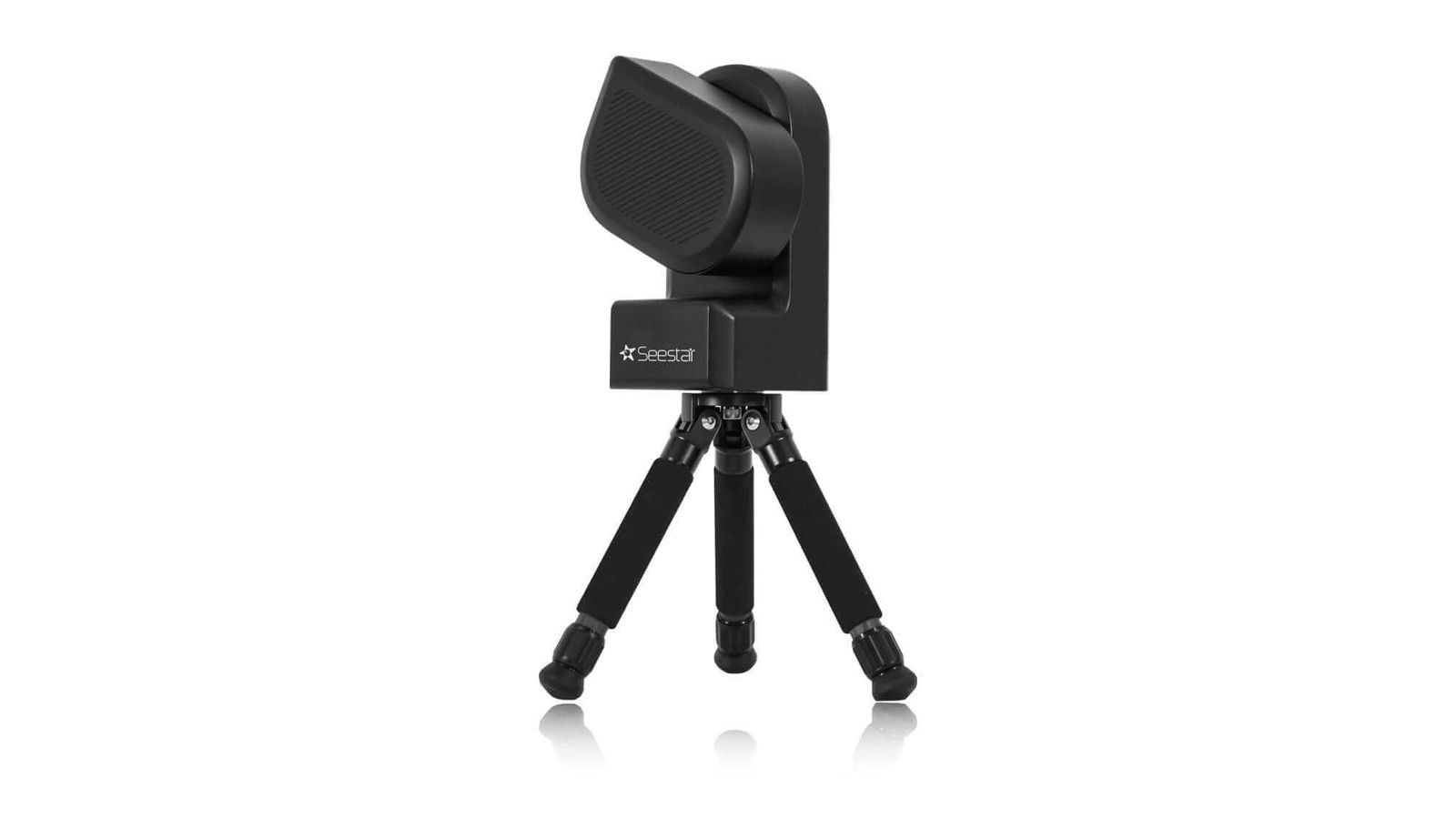
ZWO, an astronomy-optics company in Suzhou, China: its ASI cameras are standard kit for amateur astronomers worldwide. Revenue in 2024 was ¥391 million, about $55 million.
Building one for himself
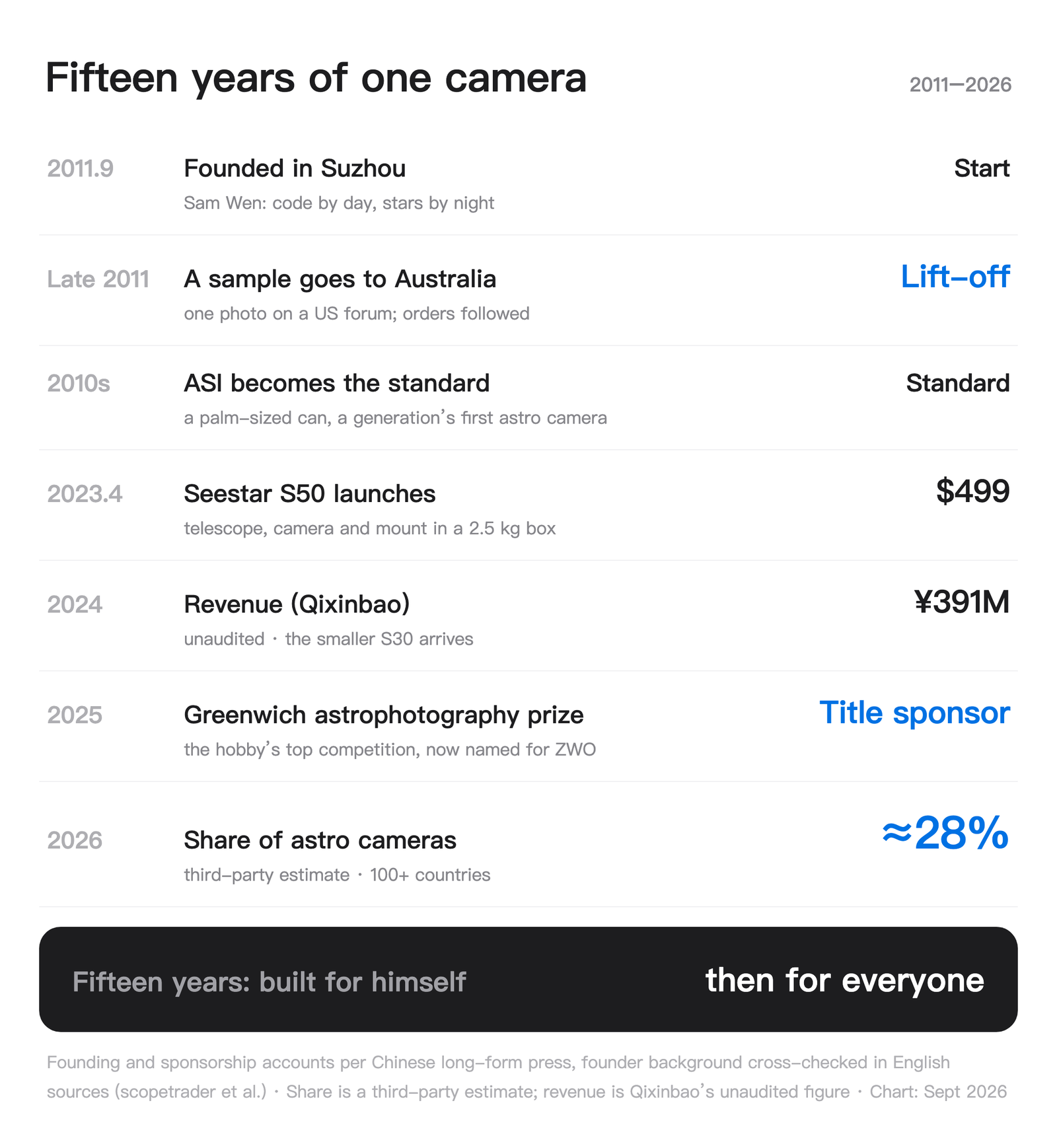
In 2011, in Suzhou, a programmer named Sam Wen (文佳) wrote code by day and watched the stars by night. He wanted to photograph the planets in his telescope, surveyed the equipment on the market, and found that hobbyists had exactly two roads. Either grit your teeth and buy a professional CCD camera, at a price that sends most people home (a full rig ran past ten thousand dollars), or buy a webcam, tear off the housing and modify it, relying on forum tutorials and luck. On one side a king's ransom, on the other side duct tape. In between, nothing. It is the same conclusion you reach today in the gear aisle of any niche hobby: the good stuff is unaffordable and the cheap stuff is unusable.
The programmer's move was direct: if you cannot afford it, build it. He put together a planetary camera for himself, then did something that looked pointless at the time. He emailed an amateur astronomer in Australia and asked him to test-shoot it, free. The Australian took a picture and posted it, offhand, on an American astronomy forum.
The orders started from that one photograph. No launch event, no advertising, not even a proper website. A cheap camera that could actually shoot, set loose among the pickiest few thousand people on Earth, grew legs of its own.
A company raised on forums
The next dozen years of ZWO can be compressed into one sentence: it squatted in the forums and did business there. Astrophotography is a tiny world; its devotees gather on a handful of English-language forums, where every claim about a product arrives with test shots attached. You cannot bluff. ZWO made this its only home field. Hobbyists posted requests, and the company built to them; users asked about specs in the small hours, and the founder himself answered. American astronomy media, recalling the early ZWO, singled out one detail: the account answering questions was, often enough, Wen himself.
In other words, this company's product managers were the world's amateurs. No market research needed, because the forums updated daily. No ad spend needed, because the test shots were the advertising. It is a slow way to work, but every step lands on solid ground.
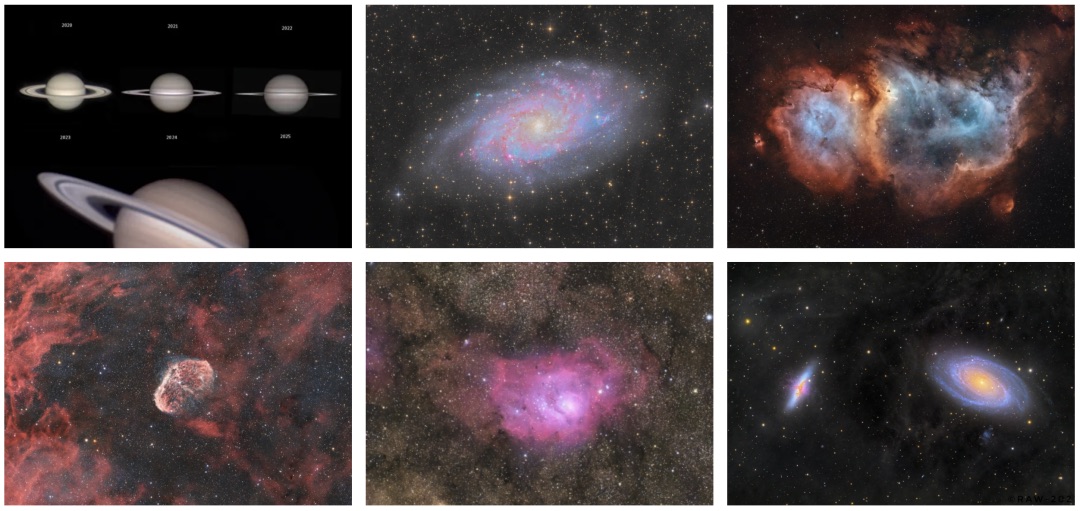
The compound interest on this clumsy method is astonishing. The early ASI120, an aluminum can the size of your palm priced at a fraction of professional gear, shot Jupiter's cloud bands and Saturn's rings sharply enough to show off. It became a generation's first astronomy camera, and it redefined what "entry-level" costs. Generation after generation, the ASI line became standard kit for amateur astronomers worldwide, sold in more than 100 countries.
American astronomy bloggers fly to Suzhou to tour the factory and come home to write long travelogues. A Chinese factory became a hobbyist landmark.
The $499 strike from above
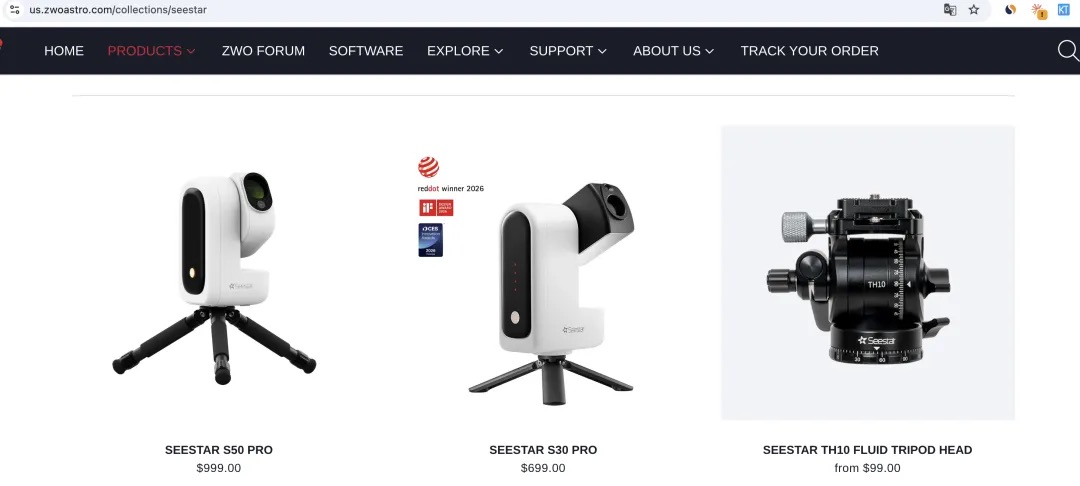
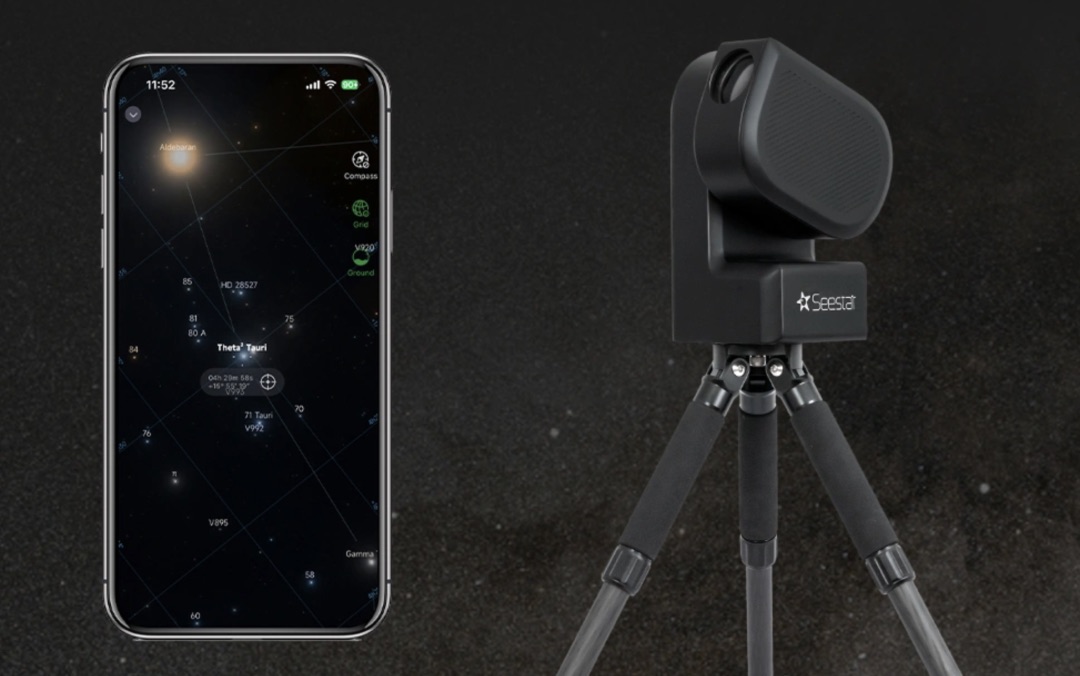
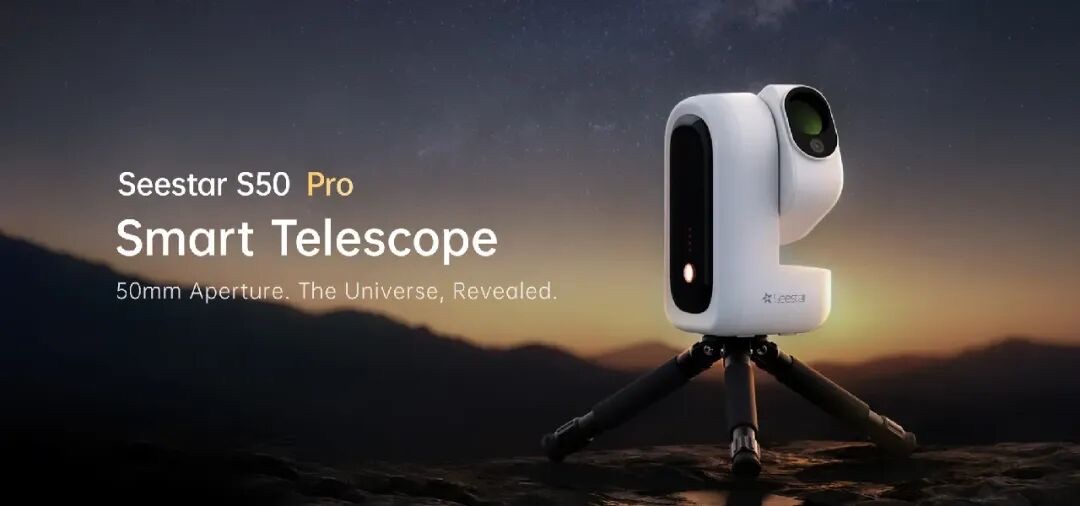
Having reached No. 1 in its niche, the company did something its peers found hard to read: it turned and attacked downmarket. In April 2023, ZWO released the Seestar S50. It packs telescope, camera, equatorial mount and battery into a 2.5-kilogram box; tap your phone once and it finds the target, focuses and stacks the frames by itself. The craft formerly known as "two hours aligning the polar axis at 3 a.m." was compressed into a single button.
The setting changed with it. It is not picky about venues: a balcony, a backyard, a light-polluted city sky. Ten minutes from power-on to a photo of a galaxy or a nebula. No right ascension or declination, no three-hour tutorials, no midnight drive into the mountains. The hobby's first hurdle used to be learning. Now it is when the courier arrives.
$499 is roughly a twentieth of a traditional starter rig. Its full force shows against the rest of the industry. France's Unistellar and Vaonis also make smart telescopes, priced at $2,000 to $4,000. Before the Seestar, one-button stargazing was a small luxury. After it, the whole category was priced like a Christmas present.
Twilight of the aristocrats
The French machines remain exquisite, and they still collect design awards, but the pricing power over one-button stargazing no longer sits in Europe. When the entry ticket falls from thousands of dollars to hundreds, there are no longer enough people willing to pay ten times as much for exquisite. Suzhou, meanwhile, did something in 2025 loaded with symbolism. The Royal Observatory Greenwich's annual astrophotography competition, the most prestigious in the world, renamed itself from its 17th edition: the ZWO Astronomy Photographer of the Year. Sixteen years of history, and the first time a Chinese brand has held the title sponsorship alone.
Consider what that means. Greenwich's competition is the Oscars of astrophotography, and a Suzhou company that grew up on forums now has its name above the title. Said in 2011, that sentence would have been a joke.
The flip side
As always in this series, the reverse of the medal. Per Qixinbao, a Chinese corporate-registry service, ZWO's 2024 revenue was ¥391 million (unaudited). What makes it formidable is not the size of its pot but its grip on a niche: in a pool that is not large, it holds nearly a third. The reviewers' consensus on the Seestar is fair. With a 50-millimeter aperture, image quality has a ceiling; it is the hobby's entry ticket, not a replacement for professional gear. The real base is still the professional ASI line. Sell the entry ticket to the public and the pro line to the devoted, and both ends of the market are ZWO's.
Epilogue
己欲立而立人,己欲达而达人。
Wishing to stand, help others stand. Wishing to arrive, help others arrive.
— Confucius, Analects
Wen's first camera was built for himself; he wanted a picture of the stars. The Seestar was built for everyone, so that anyone who has ever looked up can afford a picture of the stars too.
Do one small, ordinary thing well, decade after decade — that is extraordinary.
I'm Gu Yi (顾义), writing 1,001 stories of the world's quietly remarkable businesses. This is No. 1. May one of them matter to you.
RSS · WeChat Official Account: 跨境杂牌铺